Ultrapure Water Systems for Hydrogen and Industry
Feed water treatment for PEM, AEM and alkaline electrolyzers – the basis of green hydrogen production.
Water Treatment for Hydrogen and Industry
PEM (proton exchange membrane), AEM (anion exchange membrane) and alkaline electrolyzers require feed water with very low conductivity, since even minor impurities can damage the membrane or catalyst and reduce efficiency. Our reverse osmosis systems with a downstream EDI stage reliably deliver ultrapure water in the MΩ·cm range – the foundation for efficient, long-lasting electrolyzers and a growing range of other industrial applications.
Feed Water for Electrolysis
- Resistivity in the MΩ·cm range, or conductivity typically below 1 µS/cm – to protect the membrane and catalyst from fouling
- Consistent water quality for stable, efficient electrolysis operation
- Scalable systems from pilot plant to industrial-scale electrolyzer
Further Industrial Applications
From solar panel and façade cleaning to humidification, battery production and coating systems, right through to the automotive industry – use the tiles below to reach the detail pages for each specific area.
System Configuration
For electrolyzer feed water treatment, we combine two- to three-stage reverse osmosis with a downstream electrodeionization (EDI) stage, scalable from a pilot plant to several thousand liters per hour for continuous industrial operation. Available as an enclosed stainless steel housing, an open frame, or a cabinet system, including PLC control with conductivity monitoring and optional remote administration for unattended operation.
Customer Feedback
„Die Umkehrosmose-Anlage der Fa. IEM GmbH erfüllt unsere Anforderungen zuverlässig. Wir schätzen die kompetente Beratung und den schnellen Service aus dem Hause IEM.“
TÜV Rheinland LGA Products GmbH is part of the TÜV Rheinland Group and tests, assesses and certifies products for the global market (WZ 71.20.0, technical, physical and chemical testing) – among other things as a GS testing body under the German Product Safety Act. At its Troisdorf site near Cologne, TÜV Rheinland operates test laboratories for high-performance technologies such as battery storage, power electronics and environmental simulation. IEM's reverse osmosis system reliably supplies the testing applications there with treated water.

„Wir schätzen IEM als zuverlässigen und kompetenten Partner. Unsere Anlage läuft sehr zuverlässig, und bei technischen Problemen oder Wartungsbedarf reagiert IEM schnell, unkompliziert und lösungsorientiert. Besonders positiv erleben wir die hohe technische Kompetenz, die gute Erreichbarkeit und den stets freundlichen Kundenkontakt. Aufgrund der hohen Qualität und des kompetenten Services können wir IEM uneingeschränkt weiterempfehlen.“
DEKRA Automobil GmbH operates DIN EN ISO/IEC 17025-accredited testing laboratories for environmental simulation and corrosion testing (WZ 71.20.0, technical, physical and chemical testing) – from cyclic climate testing (-40 °C to +80 °C) to UV weathering and VOC emissions testing on vehicle components. IEM's ultrapure water system supports the testing processes in environmental simulation.
„Die Umkehrosmose erfüllt alle unsere Erwartungen und Anforderungen von der Firma IEM GmbH. Wir schätzen den schnellen Service und die kompetente Beratung im Hause IEM. Der Service ist sehr unkompliziert und wird schnellstens erledigt.“
Bernd Olschner GmbH, based in Moos on Lake Constance, has been developing and producing ultrasonic cleaning chemistry for industrial precision and ultra-fine cleaning since 1993 (WZ 20.41, manufacture of cleaning agents) – for optics, metal and carbide parts as well as EUV-compliant cleaning concentrates for semiconductor and lithography applications – including process consulting and an in-house measurement lab, with EMAS and ISO 9001 certification. Since 2017, an IEM OSL reverse osmosis system (450 l/h, with permeate conductivity monitoring) has supplied production and application engineering with demineralized water.
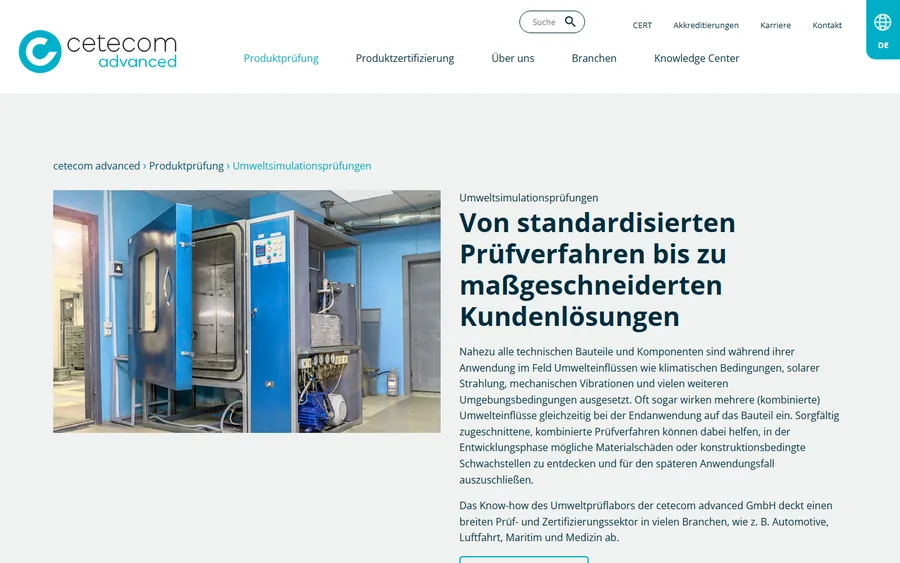
„Der Fachbereich für Batterie- und Umweltsimulationsprüfungen der cetecom advanced GmbH in Saarbrücken betreibt mit der Umkehrosmoseanlage der Fa. IEM GmbH diverse Klimaprüfschränke, Salzsprühnebelkammern sowie Xenonkammern im Rahmen der künstlichen Bewitterung. Die Umkehrosmoseanlage lässt sich tadellos in die Prozesskette integrieren, die Handhabung gestaltet sich sehr einfach und die Wasserqualität ist durchgehend auf bestem Niveau. Die cetecom advanced GmbH schätzt insbesondere den herausragenden, schnellen Vor-Ort-Service. Lieben Dank für den tollen Support.“
cetecom advanced GmbH (formerly CTC advanced) in Saarbrücken, Germany, is a DIN EN ISO/IEC 17025-accredited testing and certification laboratory (WZ 71.20.0, technical, physical and chemical testing) that supports manufacturers in automotive, medical technology, mechanical engineering and electronics with testing and market approval in more than 180 countries. Its Environmental & Battery department tests high-voltage battery systems to ECE R100/R136 and simulates environmental stress – climatic tests to IEC 60068-2 and ISO 16750-4, salt spray to DIN EN ISO 9227 and ASTM B117, and artificial weathering with xenon light to DIN EN ISO 4892-2, DIN 75220 and ASTM G155. Since 2018, an IEM ultrapure water system (2-stage reverse osmosis, EDI and mixed-bed polishing, 30 l/h, < 1 µS/cm) has supplied the water for these tests – well below the limits of < 5 µS/cm for water spray (ISO 4892-2) and ≤ 20 µS/cm for the salt solution (ISO 9227).
Service & Support
From commissioning to maintenance contracts at fixed intervals to spare parts service, we support your system throughout its entire lifecycle. Optional remote monitoring detects many issues before they lead to a production outage.
References for Hydrogen
Recommended System for Hydrogen
Reverse osmosis with an EDI stage for the feed water quality electrolyzers require.
-
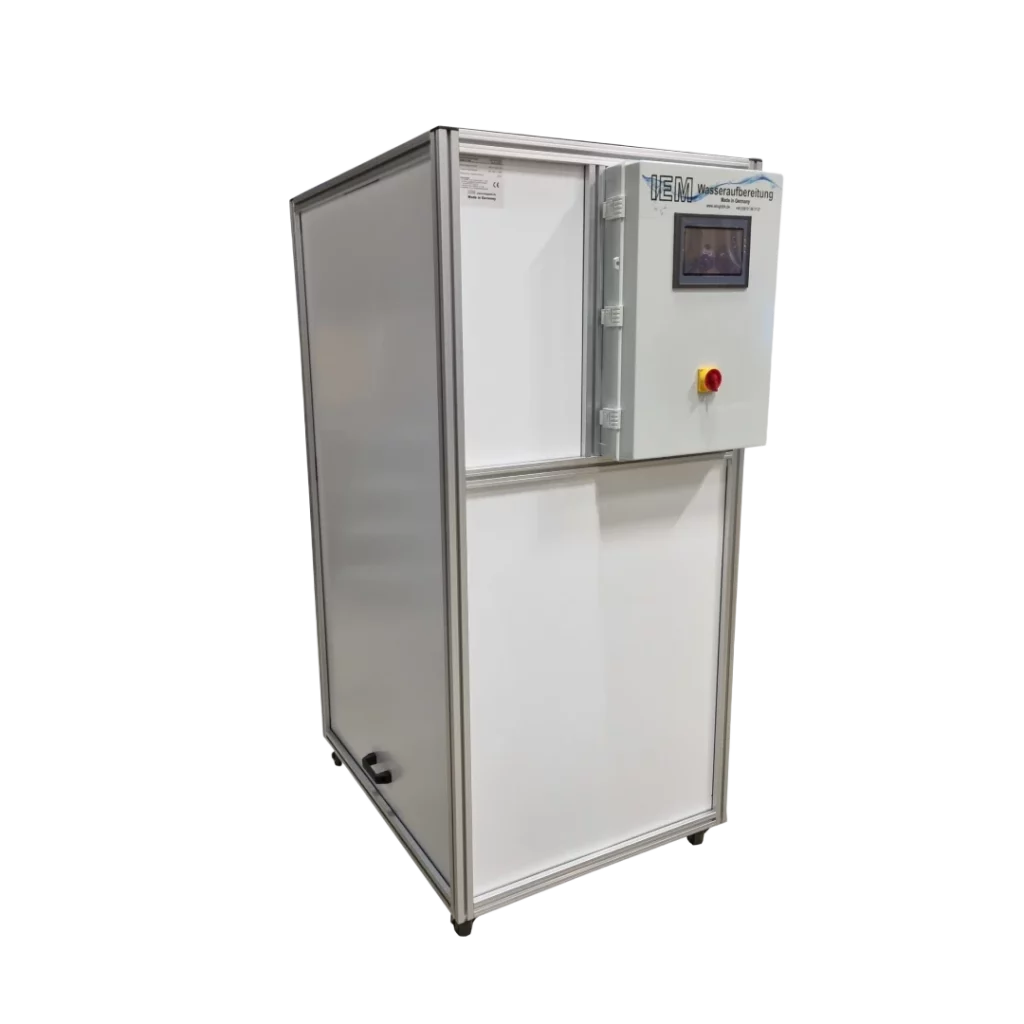
3-Stage 20 L/h EDI Ultrapure Water Reverse Osmosis System
3-Stage 20 Liter / Hour Ultrapure Water Reverse Osmosis EDI Water Treatment System (All-in-One solution)Price on request Read more- Application area: Research / Laboratory / Medicine
- 20 liters / hour (< 1 µS/cm and TOC <0.3 mg/l @15° C water temperature)
- Basic configuration:
- Stage 1 reverse osmosis system „free-standing unit Type RO4040x”
- Stage 2 reverse osmosis system „free-standing unit Type RO4021x”
- Stage 3 electrodeionization ( EDI )
- Touch screen control. An EDI unit with matching output is used for the permanent production of ultrapure water. This technology works through electrodialysis and electrodeionization. Removing bacteria in ultrapure water applications is especially critical in medical and laboratory procedures. Ultrafiltration technology ( hollow fiber membrane ) is used to kill and remove bacterial contamination with the help of ultraviolet irradiation. When integrated into a ring main, the system can also supply the entire consumer base of a laboratory facility or other requirement and permanently prevent the growth and formation of bacteria through UV and ultrafiltration.
- Basic configuration:
AEM Electrolysis: Hydrogen Production with Anion Exchange Membranes
AEM electrolysis (anion exchange membrane water electrolysis) is a process for splitting water electrochemically into hydrogen (H2) and oxygen (O2). It combines advantages of alkaline electrolysis with the compact design of membrane-based systems and offers the potential for lower material costs – provided the feed water has the right quality.
The Process in Four Steps
- Water supply: Treated water is fed to the electrolyzer. Depending on the system design, a dilute alkaline electrolyte, e.g. potassium hydroxide (KOH), is used.
- Hydrogen formation at the cathode (−): Water takes up electrons and is converted into hydrogen (H2) and hydroxide ions (OH−).
- Ion transport through the AEM: The hydroxide ions migrate through the anion exchange membrane from the cathode to the anode.
- Oxygen formation at the anode (+): The hydroxide ions release their electrons and form oxygen (O2) and water.
Electrochemical Reactions
| Cathode (−) | 2 H2O + 2 e− → H2 + 2 OH− |
|---|---|
| Anode (+) | 2 OH− → ½ O2 + H2O + 2 e− |
| Overall reaction | H2O → H2 + ½ O2 |
Water Treatment for an AEM Electrolysis Plant
For stable, long-lasting operation, the electrolyzer needs demineralized water of the quality specified by the manufacturer. A typical treatment chain:
Drinking water → Pre-filtration → Reverse osmosis (RO) → EDI or mixed-bed ion exchange → Ultrapure water tank → AEM electrolyzer
The core consists of our reverse osmosis systems with downstream EDI or mixed-bed ion exchange. The hydrogen produced is then separated, dried and used; the oxygen is separated and safely vented. More on feed water treatment for electrolyzers.
Typical Data of a Pilot Plant (Example)
| H2 production | approx. 1 kg/h (≈ 11.1 Nm³/h) |
|---|---|
| O2 production | approx. 8 kg/h |
| Water demand (theoretical) | approx. 9 L/h |
| Treated water (total, guide value) | approx. 12–20 L/h |
| Electrical power (guide value) | approx. 50–65 kW |
| Feed water quality | according to the manufacturer's specification (demineralized) |
These values are for initial guidance only and must be checked against the electrolyzer manufacturer's data for a specific plant.
Advantages and Challenges
AEM technology offers the potential for lower material costs (fewer precious-metal catalysts), a compact and modular design, good suitability for operation with renewable energy and scalability from laboratory and pilot plants to larger systems. Technical challenges include long-term membrane stability, the durability of electrodes and catalysts, safe gas separation, and water and electrolyte management – one more reason not to compromise on feed water.
Conclusion
AEM electrolysis is a promising technology for producing green hydrogen. Besides the electrolysis cell, reliable water treatment determines efficiency and service life. IEM supports such projects by planning and designing industrial water treatment systems – in particular with reverse osmosis, EDI and further desalination processes.
FAQ: AEM Electrolysis and Feed Water
AEM electrolysis (anion exchange membrane water electrolysis) splits water electrochemically into hydrogen and oxygen. An anion exchange membrane separates cathode and anode and conducts hydroxide ions (OH−). The process combines the alkaline environment of classic alkaline electrolysis with the compact design of membrane-based systems.
In PEM electrolysis, protons (H+) pass through a membrane in an acidic environment, which requires precious-metal catalysts such as platinum and iridium. Classic alkaline electrolysis uses concentrated lye and a diaphragm. AEM electrolysis transports hydroxide ions through a membrane in an alkaline environment – allowing compact cells and lower-cost catalyst materials, typically with a much more dilute electrolyte.
The electrolyzer manufacturer's specification is always decisive. As a rule, demineralized water with low conductivity is required, since dissolved salts and impurities stress the membrane, electrodes and catalysts. A combination of pre-filtration, reverse osmosis and EDI or mixed-bed ion exchange reliably achieves this quality – we design the system to match your electrolyzer.
Theoretically, about 9 liters of water are split for 1 kg of hydrogen. In practice, depending on the system design, around 12–20 liters of treated water are needed; because of the reverse osmosis concentrate, the raw water demand is somewhat higher still. The exact figure depends on the raw water quality and the recovery of the treatment system.
Don't See Your Application?
Talk to us – we also develop custom water treatment solutions for your specific application.
Get in Touch