About Reverse Osmosis
What is reverse osmosis, how does an ultrapure water system work, and which applications is it suited for? Here we answer the most important questions.
What Is Reverse Osmosis?
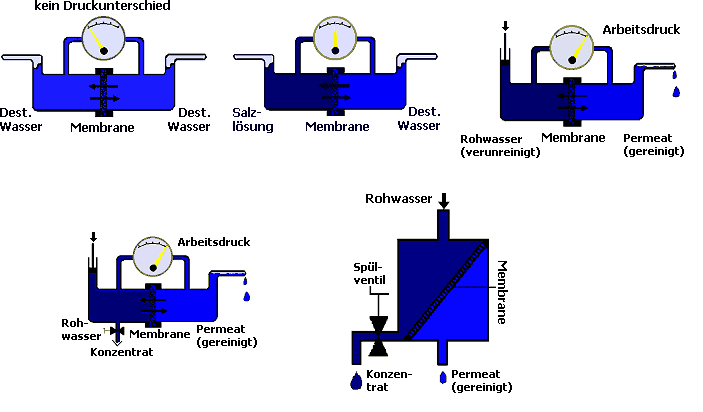
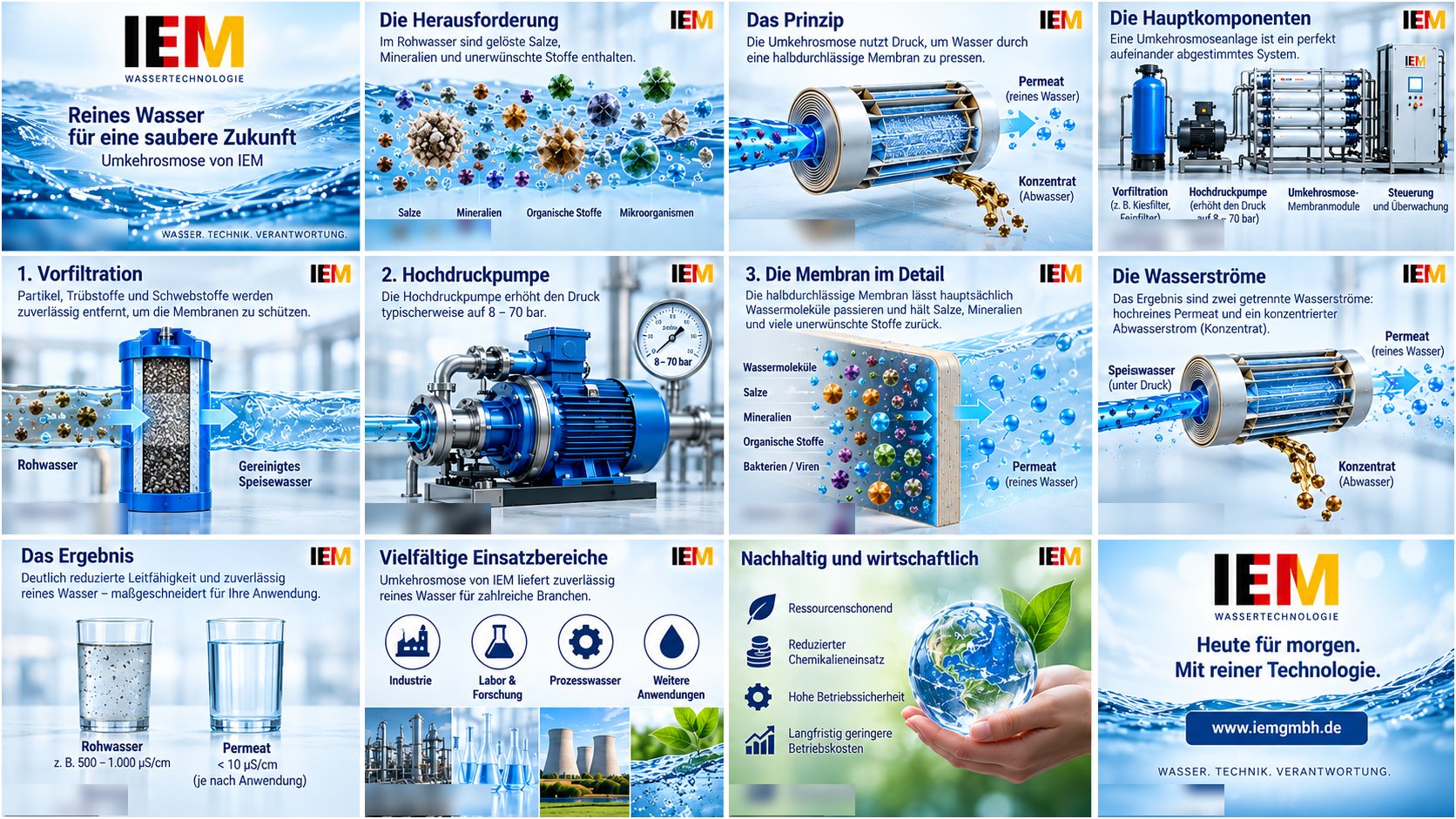
Reverse osmosis is a physical process that removes dissolved substances from water by purely mechanical means. The water is forced through a semi-permeable membrane whose pores are so fine that almost only water molecules pass through. The rejected substances aren’t collected but continuously carried off in the concentrate stream – so the environment isn’t burdened with additional chemicals.
When a semi-permeable membrane separates two liquids of different concentration, Brownian molecular motion causes more water molecules to migrate from the pure side to the contaminated side than the other way round – this is what’s known as osmotic pressure. If you artificially apply a pressure on the contaminated side that clearly exceeds the osmotic pressure, this natural flow reverses: pure water is forced through the membrane. On an industrial scale, this same principle is even used to desalinate seawater – the resulting water reaches a purity that only a few natural springs can match.
Which system suits your application – single-stage, two-stage, with EDI or mobile – is shown in our overview Reverse osmosis systems for industry, laboratories & commerce.
Reverse Osmosis Explained
Click the play button to play
Membrane, Concentrate & Where the Technology Comes From
Why Reverse Osmosis Produces Concentrate
Because feed water carrying dissolved substances keeps flowing in during operation, the substances rejected by the membrane have to be continuously flushed away so they don’t clog it. Every reverse osmosis system therefore produces concentrate (reject water) alongside the permeate – efficiency is never 100 %. To cut down on this reject water, our systems use a patented, electricity-free permeate pump that reduces the concentrate share by around 85 %.
The Membrane: the Heart of the System
Where cellulose acetate membranes used to be standard, polysulfone membranes have now become the norm. Their average service life is 5 to 7 years. Performance and yield depend, among other things, on the feed water pressure: our household systems typically operate at 2.8 to 6 bar – higher pressure increases the amount of permeate produced. Higher temperature also boosts the yield (up to 60 % more between 10 °C and 25 °C); however, temperatures above 30 °C should be avoided, as the membrane is sensitive to heat.
NASA Technology, Now for Everyone
Reverse osmosis was developed in the 1960s for NASA, for a drinking-water recycling system for crewed spaceflight. To this day, membranes from leading manufacturers are still largely made in the USA. Its most significant application today is large-scale seawater desalination; other fields include the food industry (concentrating fruit juices), medicine (dialysis), and industrial wastewater recycling. In the US, an osmosis-based water filter has long been standard equipment in many kitchens.
How Does an Ultrapure Water System Work?
Our systems combine several treatment stages, each removing different types of contaminants – until only extremely pure water remains.
1. Pre-treatment
Mechanical filters (e.g. sand or cartridge filters) remove coarse particles, activated carbon adsorbs chlorine and organic substances, and softening prevents scale buildup – all to protect the membranes downstream.
2. Two-Stage Reverse Osmosis (RO)
Two treatment stages remove 95–99 % of dissolved salts, organic substances and microorganisms. The two-stage design provides higher reliability and better water quality.
3. Electrodeionization (EDI)
Ion-exchange resins and an electric field continuously remove virtually all remaining dissolved salts without any chemicals – conductivity drops to below 0.2 µS/cm.
4. Polishing (Final Purification)
Ultrafiltration, UV irradiation and fine ion exchange achieve resistivity of up to 18.2 MΩ·cm. A final filter ensures sterile, germ-free delivery of ultrapure water to ASTM Type I.
FAQ: Ultrapure Water Systems at IEM
Ultrapure water is classified internationally by its purity:
| Type | Purity | Typical applications |
|---|---|---|
| I | Highest purity (e.g. 18.2 MΩ·cm, TOC < 10 ppb) | HPLC, cell culture, molecular-biology applications |
| II | High purity (≥ 1 MΩ·cm) | General laboratory analytics, reagent and buffer preparation |
| III | Medium purity (≥ 0.05 MΩ·cm) | Pre-filtration for Type I, glassware rinsing, less critical work |
Note: A „Type IV“ is not an official ASTM category, but is often used in practice for raw or pre-treatment water.
Whether research, production or critical industrial processes – wherever the highest water quality is required, our ultrapure water systems deliver the right solution, including for:
- University and research laboratories
- Pharmaceutical development and quality assurance
- Biotechnology and cell culture
- Food and beverage industry
- Semiconductor and electronics manufacturing
- Medical device and hospital supply
- Hydrogen production, e.g. for PEM electrolysis with high-purity water
- Nuclear energy, e.g. for reactor cooling, moderator water or lab analytics
Yes – all our water treatment systems are custom-engineered solutions. Each system is designed based on a feed water analysis and the ultrapure water quality required for the application. In particular, we take into account:
- Water demand (l/h or l/d)
- Space available on site
- Purity requirements
- Connection to existing infrastructure
- Validation (GMP, IQ/OQ) and optional remote monitoring
Of course – we offer comprehensive service around your system:
- Installation and commissioning
- Maintenance contracts with fixed intervals
- Remote monitoring for continuous system oversight
- Calibration and validation
- Spare parts service and complete documentation
- Training your staff for safe, efficient operation
- Standard systems are often available at short notice
- Custom systems (incl. engineering & documentation): approx. 6–14 weeks
- Express delivery and an expedited project start possible by arrangement
You can reach us by phone at +49 6131 963107 or by email at info@iemgmbh.de. Alternatively, simply use our contact form or our Configurator for a non-binding budget estimate.
Depending on the series, from around 10 l/h for small laboratory and mobile systems up to 2,500 l/h for large stationary industrial systems. For higher outputs, we build multi-train or fully custom systems.
Typically drinking-water quality, filtered to roughly 5 µm, with a minimum feed pressure of 1 bar, a temperature between 4 and 30 °C, and a maximum free chlorine content of 0.1 mg/l – exact limits vary by system type and are designed around your actual feed water analysis.
Usually a 3/4-inch water connection (1-inch for larger systems) and a 230 V AC power supply (230/400 V AC for larger systems), fused at 16 A with a residual-current device. A free concentrate drain and ideally a floor drain at the installation site are recommended.
Pre-filtration, high-pressure pump, membrane(s) with membrane housing, PLC control, conductivity display, flow and pressure sensors, dry-run protection, and a flushing system – all components are matched to each other and vary in specification by model.
1 year or up to 3,000 operating hours from the delivery date, whichever comes first.
Our online shop has filters, membranes, pumps, valves, pressure tanks, PLC controls, and other accessories available to order directly.
Today's standard polysulfone membrane has an average service life of 5 to 7 years. How quickly it actually wears depends heavily on raw water quality, operating pressure and suitable pre-treatment – regular maintenance and the right pre-filtration can noticeably extend its lifespan.
Every reverse osmosis system produces concentrate alongside the permeate, since efficiency never reaches 100 %. Our systems use a patented, electricity-free permeate pump for this, which reduces the reject water share by around 85 % – significantly more resource-efficient than standard systems without this technology.
Both processes remove dissolved salts from water, but work differently: ion-exchange resins bind ions chemically and need to be regenerated regularly, whereas reverse osmosis retains dissolved substances by purely mechanical means via a membrane, with no chemicals involved. In practice, we often combine both processes – for example, reverse osmosis as the main stage with a downstream electrodeionization (EDI) stage for the highest purity levels.
Depending on the installation site and requirements, we supply our systems in four housing variants:
- Stainless steel housing – for environments with high hygiene and appearance requirements, e.g. in the medical and food sectors
- Mobile – mounted on castors, flexible for changing installation locations
- Open frame – openly accessible for maintenance, ideal for integration into existing infrastructure
- Cabinet system – fully enclosed, space-saving and protected from dust and contact
In many cases, yes – whether additional treatment stages (e.g. a downstream EDI stage for higher purity), more capacity or remote monitoring: simply contact us with the key data of your existing system, and we'll individually assess the retrofit options.
Under our maintenance contracts, we support you in the event of a fault with spare parts service and personal support. Where remote monitoring is set up, we often detect problems before they lead to a failure at all.
Ultrapure water from a reverse osmosis system is designed for technical, medical and laboratory-analytical applications, not as a substitute for drinking water. Drinking water applications require a different system design with appropriate remineralization and a hygiene concept – please contact us directly if you have this need.
A single reverse osmosis stage reduces conductivity by 95–99 %, with the exact result depending on raw water quality – already sufficient for most industrial applications. If an additional EDI stage is added downstream, conductivity drops further to below 0.1 µS/cm (up to 18.2 MΩ·cm), as required for ultrapure water applications to ASTM Type I.
If the water quality from a reverse osmosis stage alone (ASTM Type II–III) isn't sufficient for the application – for example in HPLC, cell culture or other highly sensitive lab and production processes – an electrodeionization (EDI) stage is added downstream. It continuously removes the remaining dissolved salts without chemicals, achieving ultrapure water to ASTM Type I.
The two terms are often confused: deionized (DI) water refers to water that has had dissolved salts removed, typically in the ASTM Type II–III range – sufficient for many general lab and industrial applications. Ultrapure water refers to the highest purity level (ASTM Type I, from 18.2 MΩ·cm), as needed for e.g. HPLC or cell culture, and generally requires an additional EDI and polishing stage.
PEM and alkaline electrolyzers require feed water with very low conductivity, since even minor impurities can damage the membrane or catalyst and reduce efficiency. Depending on the electrolyzer type and manufacturer specification, this typically calls for a reverse osmosis system with a downstream EDI stage, reliably delivering ultrapure water in the MΩ·cm range.
Still Have Questions About Reverse Osmosis or Ultrapure Water?
Our team is happy to advise you on your custom water treatment solution.
Get in Touch